

How Kia & Hyundai are Redefining Driver Safety Technology
Hyundai and Kia keep raising the bar for driver safety! They recently partnered to develop a new driver safety technology called ‘Vision Pulse.’ This revolutionary technology uses ultra-wide band (UWB) signals to accurately pinpoint the position of obstacles around the vehicle in real-time.
…
Vision Pulse Technology utilizes UWB modules installed in vehicles to emit signals. A UWB signal is a type of radio signal that operates across a wide frequency range. What sets it apart from other wireless technology is its pulse-based signaling. It transmits ultra short duration pulses, often just a few nanoseconds, which allows for high precision and low interference. A lot of modern devices, like smartphones, Airtags, and certain wearables, utilize UWB technology. Vision Pulse technology uses those signals to calculate the distance between objects, looking at how long it takes the signals to travel from one object to the other. These quick pulses allow for more accurate positioning than other technologies. Then, when the system detects a potential collision, it issues alerts, reducing the likelihood of an accident.
…
Many current driver safety technologies rely on fixed devices or slower communication networks, which hinder accuracy and processing speed. UWB’s short, fast, and frequent pulses combat these limitations and lead to high accuracy and low interference. In tests, the system has communication speeds of 1-5 milliseconds, providing real-time updates. These systems are relatively cost-effective as well, as UWB modules are already in many vehicles, and are cheaper than expensive LiDAR and radar sensors.
…
UWB operates on a separate bandwidth which eliminates almost all interference from other signals. Vision Pulse has already shown to be highly accurate, maintaining over 99% detection accuracy, even under adverse weather and nighttime conditions. In complex urban intersections, it detects objects with an impressive 10cm margin of error. Additionally, Hyundai and Kia developed and applied algorithms to this tech that are able to accurately predict the positions of multiple objects.
…
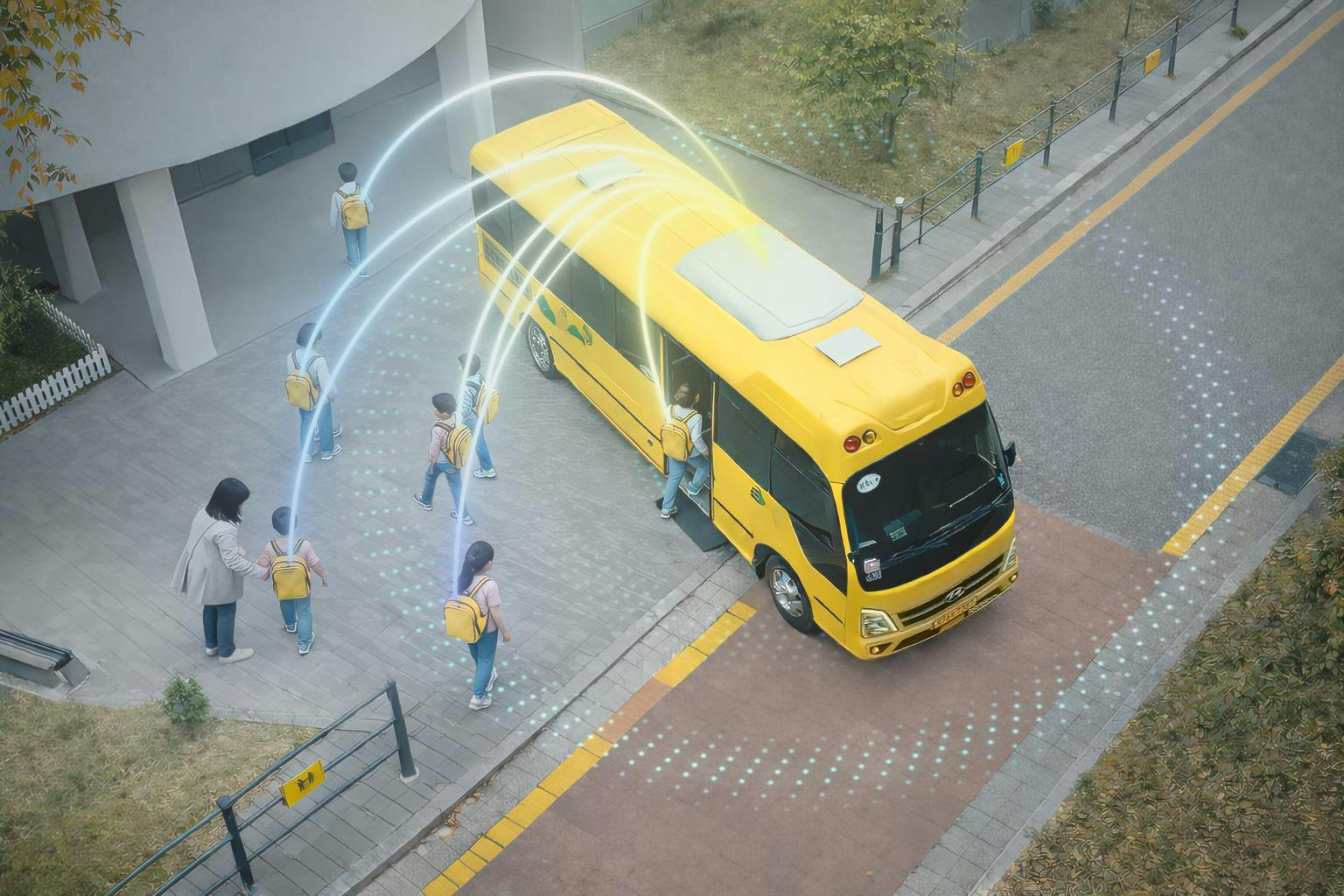
A recent campaign video showed how Vision Pulse can be utilized in school buses to ensure student safety. Small keyrings that emit UWB signals are attached to students’ backpacks, allowing the bus to clearly see students’ movements. Currently, Hyundai and Kia are testing Vision Pulse in live industrial settings in South Korea to prevent workplace collisions between workers and forklifts. Looking ahead, Hyundai and Kia hope to utilize this technology in many other segments. It can be used in industrial settings to reduce collisions, and in disaster settings to help locate individuals buried under debris in emergencies.
